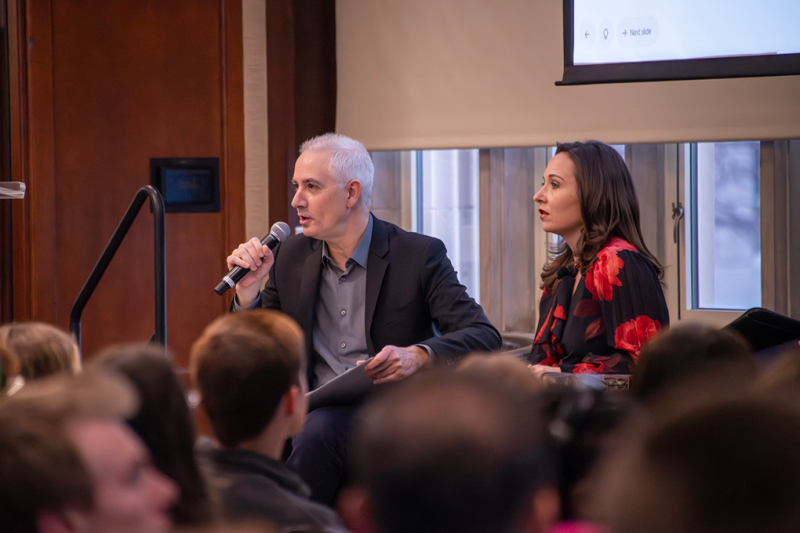
Image: Open Minds Initiative Director Brian Kisida with panelist Lindsey Cormack
Mizzou’s Open Minds Initiative welcomed educators and policymakers on March 12 to discuss how civic education can help shape the future of democracy.
Held during National Civic Learning Week, the program, hosted in partnership with American Public Square and the Missouri Civic Learning Coalition, featured three panelists representing research, classroom experience, and state education policy.
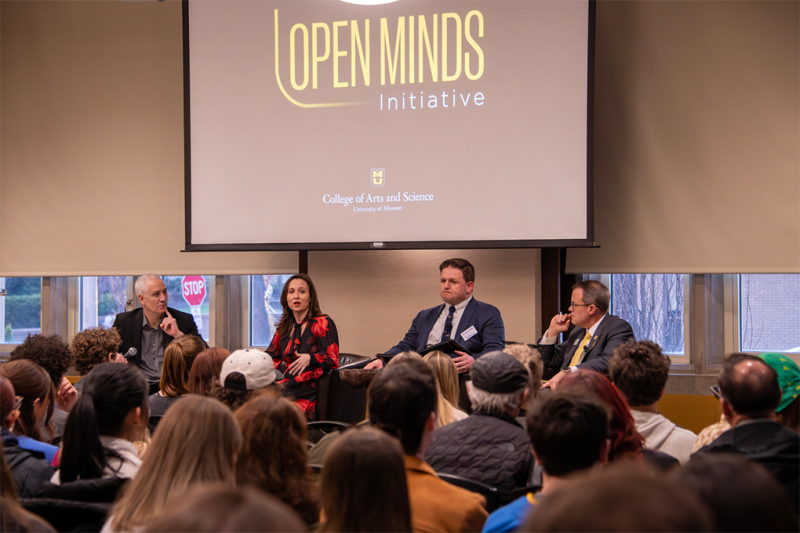
Image: Open Minds Initiative Director Brian Kisida with panelists: Lindsey Cormack, Tyler Janke, and Nathan McAlister
Lindsey Cormack, associate professor of Political Science and Director of the Diplomacy Lab at Stevens Institute of Technology, highlighted limited civics course requirements nationwide and persistently low voter participation among young people.
Tyler Janke, director of social studies and personal finance at the Missouri Department of Elementary and Secondary Education, and Nathan McAlister, humanities program manager for the Kansas State Department of Education. shared how Missouri and Kansas are working to strengthen civics education, including efforts to expand recognition programs.
Missouri has proposed a Seal of Civic Recognition for students who meet specific criteria, building on the state’s existing requirements that seniors pass a civics test to graduate.
Panelists also emphasized the broader challenge facing the field: civic education only receives a fraction of the funding dedicated to STEM disciplines, contributing to gaps in civic knowledge, skills, and participation.
The Open Minds Initiative is a comprehensive effort to strengthen the promise of higher education by hosting events and engagements where the free exchange of ideas and constructive disagreement are celebrated as essential pillars of education and truth-seeking.